

How to Calculate Woven Wire Mesh Weight per Square Metre
The formula for square weave wire mesh weight in kg/m², with pitch, wire diameter and density explained, plus two worked examples in SS 304 and mild steel.
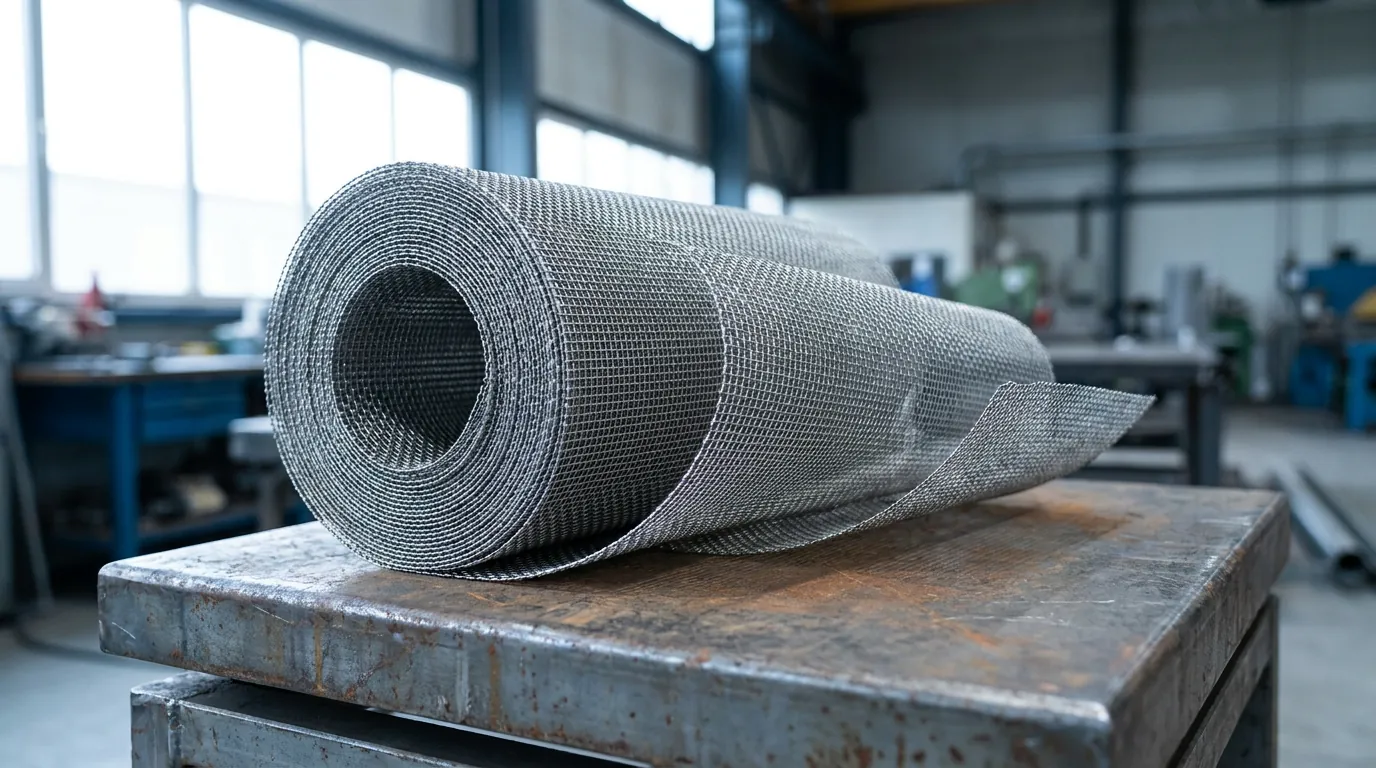
Wire mesh is usually quoted by area, but it is shipped, lifted and paid for by weight. Knowing the weight per square metre before you order helps you check a quotation, plan freight and confirm that a frame or screen deck can carry the panel. For square weave mesh the calculation is simple once you know three numbers: the pitch, the wire diameter and the material density.
The formula
This is the formula used in our wire mesh weight calculator:
Weight (kg/m²) = 2 × (1000 ÷ pitch) × (π × d² ÷ 4) × density ÷ 1000 × 1.02
- pitch is the centre to centre distance between wires in mm. If you know the mesh count, pitch = 25.4 ÷ mesh count. If you know the aperture, pitch = aperture + wire diameter.
- d is the wire diameter in mm.
- density is in g/cm³.
- 1000 ÷ pitch is the number of wires per metre in one direction. The factor 2 counts both warp and weft.
- π × d² ÷ 4 is the cross-section area of one wire in mm².
- 1.02 is a 2% allowance for the extra wire length taken up by the crimp as wires pass over and under each other.
The units work out neatly. Wires per metre multiplied by cross-section area in mm² and by density in g/cm³ gives grams per square metre, and dividing by 1000 gives kg/m².
Material densities
| Material | Density (g/cm³) |
|---|---|
| Stainless steel 304 | 7.93 |
| Mild steel | 7.85 |
| Aluminium | 2.7 |
Stainless 316 is very close to 304 for this purpose. Galvanised wire weighs slightly more than bare mild steel because of the zinc coating, so treat the mild steel figure as a minimum.
Two worked examples
18 mesh × 0.25 mm wire in SS 304. Pitch = 25.4 ÷ 18 = 1.411 mm, so there are about 708.7 wires per metre in each direction. Wire area = π × 0.25² ÷ 4 = 0.0491 mm². Weight = 2 × 708.7 × 0.0491 × 7.93 ÷ 1000 × 1.02, which comes to about 0.563 kg/m².
4 mesh × 2 mm wire in mild steel. Pitch = 25.4 ÷ 4 = 6.35 mm, giving about 157.5 wires per metre. Wire area = π × 2² ÷ 4 = 3.142 mm². Weight = 2 × 157.5 × 3.142 × 7.85 ÷ 1000 × 1.02, which comes to about 7.92 kg/m².
Notice how much the wire diameter drives the result. The second mesh has eight times the wire diameter but far fewer wires, and it still weighs about fourteen times as much per square metre, because weight rises with the square of the diameter.
Why the weight matters
- Freight: transporters charge by weight and volume. A few hundred square metres of heavy screening mesh can change the vehicle you need.
- Cost: wire is bought by the kilogram, so the weight per square metre is a fair way to compare two quotes for the same specification.
- Structure: a screen deck, guard frame or infill panel has to carry the mesh plus any load on it. Heavy mesh on a light frame sags.
- Handling: knowing the roll or panel weight in advance tells site teams whether they need a hoist.
Limits of the calculation
The formula is accurate for square plain weave and close for square twill. It does not cover Dutch weaves, rectangular openings with different warp and weft wires, or heavily pre-crimped mesh, where the 2% allowance can be too low. Actual weight also varies with wire diameter tolerance, which is set by the relevant IS or ASTM standard, so treat the answer as a good estimate rather than a guaranteed figure. If you are converting gauge to millimetres first, use the SWG to mm table, and see mesh count vs aperture if you need to move between the two ways of describing an opening.
Gujarat Wire Nettings makes woven wire mesh in stainless steel, mild steel, galvanised and other materials. Send your mesh count or aperture, wire diameter, material and quantity through our contact page, and we will confirm the specification and quote.