

Expanded Metal Guide: Raised, Flattened, LWD and SWD
How expanded metal is slit and stretched from sheet, raised vs flattened, how to read LWD, SWD and strand, and where it is used.
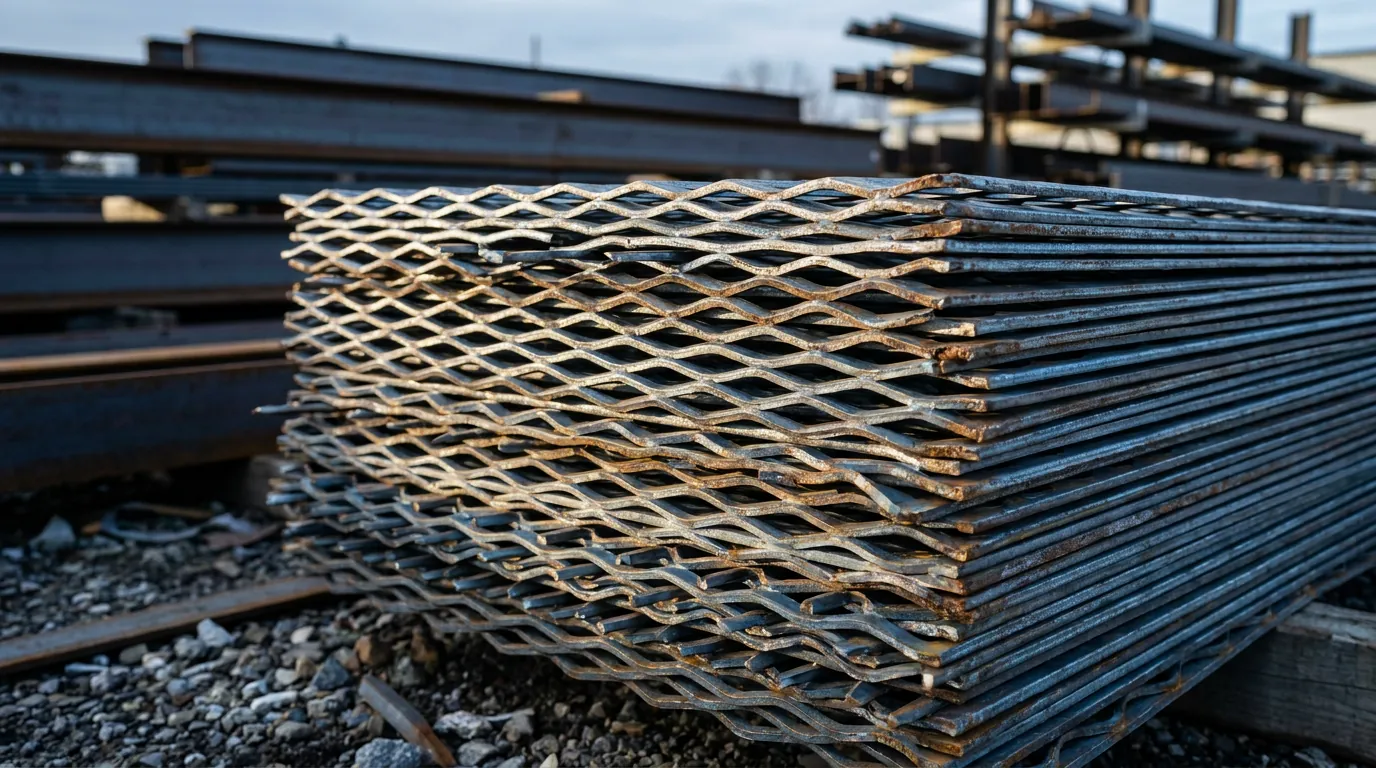
Expanded metal is a single sheet of metal that has been slit and stretched into a pattern of diamond shaped openings. There are no welds and no woven joints, so the strands and the bonds where they meet are all one piece. It is used for walkways, guards, plaster lath, fencing and building facades, and it is often a lower cost alternative to perforated sheet or welded mesh for the same opening.
How it is made
A flat sheet or coil is fed into an expanding press. A shaped blade cuts a row of short slits and, in the same stroke, pushes the metal forward so the slits open into diamonds. The sheet advances, the blade shifts by half a pattern, and the next row is cut and stretched. Because the metal is stretched and not punched out, very little material is lost. The finished sheet covers a larger area than the original blank and weighs less per square metre.
Common materials are mild steel, galvanised steel, stainless steel and aluminium. Mild steel expanded metal is often galvanised or painted after expansion for outdoor use.
Raised and flattened
Straight off the press, expanded metal is raised, also called standard. The strands sit at an angle to the plane of the sheet, which gives a rough, three dimensional surface. That surface gives grip underfoot and adds stiffness, which is why raised mesh is used for walkways, ramps and platforms.
Flattened expanded metal has been passed through a cold rolling mill after expansion. The strands are pressed flat, so the surface is smooth and the sheet lies flat. Flattening thins the strands slightly and changes the pattern dimensions a little, so check the flattened sizes with your supplier rather than assuming they match the raised figures. Flattened mesh suits guards, cladding, shelving and anywhere a smooth face is needed.
Reading LWD, SWD and strand
Expanded metal is specified by its diamond size and its strand. The terms are:
- LWD, long way of diamond: the distance between centres of two bonds measured along the long diagonal of the diamond.
- SWD, short way of diamond: the same measurement along the short diagonal.
- Strand width: how much metal is fed forward for each cut, which sets the width of each strand.
- Strand thickness: normally the thickness of the original sheet.
- Opening: the clear gap inside the diamond, smaller than LWD and SWD because the strands take up space.
LWD and SWD are centre measurements, not clear openings. If you need a minimum clear gap, for example to stop a hand or a tool passing through a guard, ask for the opening size as well. Also state which direction the LWD should run on your sheet, because it affects stiffness: a sheet is stiffer when supported across the SWD.
Where it is used
- Walkways, catwalks and stair treads, usually raised heavy gauge mild steel, often galvanised.
- Machine guards and enclosures, raised or flattened depending on the face needed.
- Plaster lath, light gauge mesh fixed to walls and ceilings as a key for plaster.
- Fencing and security panels, framed in angle or flat.
- Facades, sunscreens and ceilings, often aluminium or stainless for appearance and weight.
- Filter supports and air intake screens.
What to put on an enquiry
Give the material and finish, raised or flattened, LWD × SWD, strand width and thickness, sheet size, and the direction of LWD. If the mesh will carry foot traffic, state the span between supports and the load so the strand can be checked. For comparison with punched sheet, see perforated sheet open area.
Gujarat Wire Nettings makes expanded metal in raised and flattened forms. Send your diamond size, strand, material and sheet size through the contact page, and we will confirm what can be made.