

Perforated Sheet Hole Patterns: Round, Square, Slotted and Hex
Round, square, slotted and hexagonal holes, straight and 60° staggered layouts, and which perforated sheet pattern suits which job.
A perforated sheet is defined by three things: the hole shape, the way the holes are arranged, and the sheet itself. The first two decide open area, strength, how material flows through and how the sheet looks. This guide covers the common shapes and layouts and where each one fits.
Hole shapes
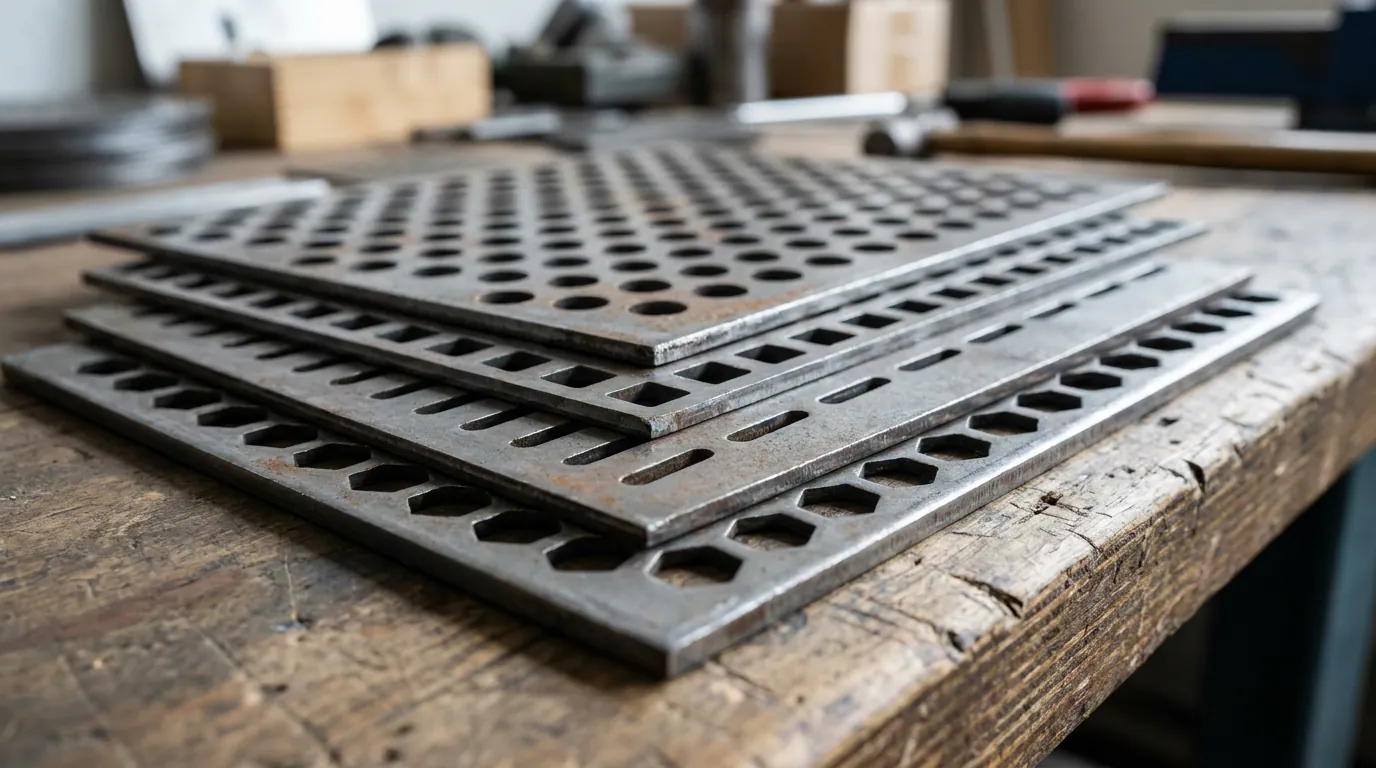
Round holes are the most common. Round punches are simple to make and maintain, they wear evenly, and the curved edge spreads stress well, so round hole sheets are usually the cheapest and the most widely stocked. Use them for guards, grilles, filters, dryer trays, silencers and general screening.
Square holes give more open area than round holes at the same pitch, because a square fills more of the space between neighbours. The sharp corners concentrate stress, so the bridges need to be a little more generous. Square holes are used for sizing and grading where a defined square aperture is wanted, and for architectural panels with a grid look.
Slotted holes are long, narrow openings with round or square ends. They pass material in one direction while holding back oversize in the other, which makes them useful for dewatering, grain and seed cleaning, and screens where a long particle should pass end on. The slot direction, along or across the sheet, matters for both strength and flow, so state it on the drawing.
Hexagonal holes give the highest open area of the common shapes, since hexagons pack with uniform bridges on all sides. They are used where maximum airflow or light is wanted with an even bridge width, for example in speaker grilles, ventilation panels and decorative work. The punches cost more to make than round ones.
Straight and staggered layouts
Holes can be arranged in a straight line pattern, where rows and columns line up in a square grid, or in a staggered pattern, where each row is offset by half a pitch.
- 60° staggered: the centres of any three neighbouring holes form an equilateral triangle. This is the most common layout for round holes. It packs more holes into a given area and gives uniform bridge width, so it delivers higher open area and better strength than a straight layout at the same hole size and pitch.
- Straight (square) pitch: holes in a square grid. Bridges are wider at the diagonals than between neighbours, so open area is lower. It is chosen for appearance, or where the holes must line up with something else.
- 45° staggered: a square grid rotated by 45°, mainly used with square holes for a diamond look.
- Slotted layouts: slots can be in line or staggered, side by side or end to end. Staggered slots keep the sheet stiffer than slots lined up end to end.
For how hole size and pitch turn into a percentage, see how to calculate open area.
Which pattern suits which job
| Application | Common choice | Reason |
|---|---|---|
| Machine guards, ventilation | Round, 60° staggered | Economical, even strength, good airflow |
| Sizing and grading | Round or square, staggered | Defined aperture, consistent cut point |
| Dewatering, grain cleaning | Slotted | Passes long particles, drains fast |
| Acoustic panels, speaker grilles | Small round or hex | High open area with fine holes |
| Facades and screens | Any, often round or square | Chosen for look, light and privacy |
Specifying the pattern
A complete order states hole shape and size, pitch (centre to centre), layout and its angle, sheet thickness, material, sheet size, and any margins left unperforated. For slots, give both slot dimensions and their direction relative to the sheet length. A small sketch removes most ambiguity, because the word staggered alone does not tell the supplier whether you mean 60° or 45°, or which way the rows run.
Hole size also has limits set by sheet thickness and material. Very small holes in thick or hard sheet wear punches quickly or cannot be punched at all. See hole size and sheet thickness before you fix a design.
Gujarat Wire Nettings makes perforated sheets in round, square, slotted and other hole patterns. Send your hole size, pitch, layout, thickness, material and sheet size through the contact page and we will reply with what we can make.